Pho Dreams and Streetlight Secrets: Eating My Way Through Ho Chi Minh City
Ho Chi Minh City hits you with energy—honking scooters, glowing street stalls, the smell of grilled meat and lime. I went for the food but stayed for the soul of the city, hidden in steaming bowls and sidewalk cafes. Every bite told a story, from French-influenced cafes to spicy noodle soups at midnight. This isn’t just eating—it’s a cultural deep dive, one flavor at a time. You don’t taste Vietnam here; you feel it.
First Bite, Lasting Impression
Arriving in Ho Chi Minh City after a long flight, the first thing that strikes you isn’t the heat, though that comes quickly enough, but the sheer volume of life unfolding on two wheels. Scooters weave through traffic like schools of fish, carrying everything from entire families to stacks of furniture. The air hums with urgency and possibility. In District 1, the heart of the city, neon signs flicker above sidewalk stalls where steam rises from pots of simmering broth. It’s here, just steps from the bustling Ben Thanh Market, that many travelers experience their first true taste of Saigon—a humble bánh mì.
The sandwich appears unassuming: a crisp, airy baguette split open and filled with pâté, pickled vegetables, cilantro, chili, and slices of meat, often cold cuts or grilled pork. Yet this simple handheld meal is a masterpiece of cultural fusion. The French introduced the baguette during colonial rule, but the Vietnamese transformed it, adapting it to local tastes and ingredients. What results is a perfect balance of textures and flavors—crunchy, tangy, savory, spicy—all contained in a package you can eat while standing on the sidewalk. It’s not just convenient; it’s emblematic.
Street food is the lifeblood of Ho Chi Minh City, not merely a tourist attraction but a fundamental part of daily existence. For locals, breakfast might be a quick bánh mì from a familiar vendor, lunch a steaming bowl of noodles from a cart near the office, and dinner a shared platter of grilled meats at a plastic-tabled alleyway eatery. This rhythm of eating on the move isn’t born of haste alone but of a deeply ingrained food culture that values freshness, accessibility, and community. Meals are not isolated events but threads woven into the fabric of everyday life.
What makes street food so vital is its authenticity. Dishes are prepared fresh throughout the day, often by the same family for decades. There’s no need for elaborate menus or fancy decor—the quality speaks for itself. A vendor might serve only one or two items, perfected over years of repetition. This focus ensures consistency and depth of flavor that many restaurants struggle to match. Moreover, the affordability of street food means it remains accessible to people from all walks of life, reinforcing its role as a great social equalizer.
Food in Vietnam is more than sustenance; it’s a language of connection. Sharing a meal, even silently alongside strangers at a shared table, fosters a quiet sense of belonging. It’s common to see office workers, students, and motorbike drivers sitting side by side, all focused on the same bowl of soup. In these moments, differences dissolve, and what remains is a shared appreciation for good food, well made. To eat in Ho Chi Minh City is to participate in this unspoken ritual, to become, however briefly, part of the city’s living rhythm.
The Soul of Saigon in a Bowl of Pho
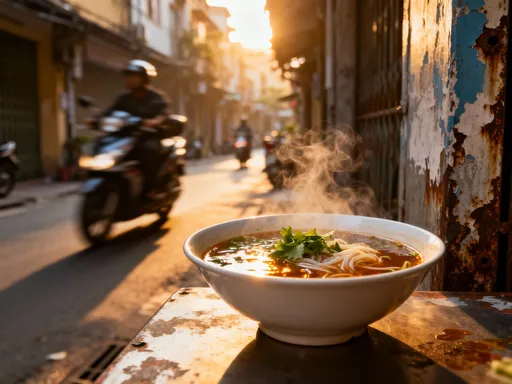
If bánh mì is the city’s bold introduction, then pho is its poetic refrain. No visit to Ho Chi Minh City is complete without experiencing this iconic noodle soup, ideally at dawn when the streets are still cool and the city stirs to life. Locals flock to their favorite pho spots before work, claiming small plastic stools at pavement tables, eager for their morning ritual. The scene is both ordinary and profound: steam rising from wide bowls, chopsticks stirring noodles, the occasional clink of spoons against ceramic. This is not fine dining; it’s daily devotion.
Authentic pho is a study in balance and patience. The broth, the soul of the dish, simmers for hours—sometimes overnight—with beef bones, charred onions, ginger, and a blend of spices including star anise, cinnamon, and cloves. The result is a clear, fragrant liquid that is rich without being heavy, aromatic without overpowering. Rice noodles, tender and slightly chewy, form the base. Thinly sliced beef, often raw when served and cooked gently by the hot broth, adds depth. Fresh herbs like Thai basil, sawtooth coriander, and bean sprouts bring brightness, while lime and chili allow each diner to tailor the flavor to their liking.
The origins of pho trace back to the early 20th century, emerging in northern Vietnam as a fusion of Vietnamese ingredients and French culinary techniques. Some historians suggest the name itself may derive from the French word pot-au-feu, a slow-cooked beef stew. Over time, the dish evolved, adapting to regional tastes. In Ho Chi Minh City, the southern style tends to be slightly sweeter, with more herbs and a more generous use of condiments. This regional variation reflects Vietnam’s culinary diversity, where geography, history, and personal preference shape even the most beloved dishes.
To eat pho like a local is to respect its integrity. Ketchup has no place here. Instead, a squeeze of lime, a dash of chili sauce, and a spoonful of hoisin might be added, but sparingly. The goal is not to mask the broth but to enhance it. Slurping the noodles is not just acceptable; it’s encouraged, as it aerates the soup and cools it slightly. The experience is tactile and immersive—hands wrapped around a warm bowl, eyes scanning the street, ears tuned to the morning sounds of the city. In that moment, you are not a visitor. You are part of the rhythm.
For many Vietnamese, pho is more than a meal; it’s a touchstone. It’s what mothers serve when children are sick, what families eat on special mornings, what travelers crave when abroad. Its simplicity belies its emotional weight. In Ho Chi Minh City, where change moves swiftly, pho remains a constant, a dish that grounds people in tradition even as the world around them transforms. To share a bowl is to share in that continuity, to taste not just flavor but memory.
Hidden Flavors in the Alleys of District 3
Beyond the well-trodden paths of District 1 lies a different Saigon—one that reveals itself slowly, tucked behind unmarked doors and down narrow alleyways. District 3, with its quieter streets and colonial-era homes, offers a glimpse into the city’s more intimate culinary world. Here, food is not performed for cameras but lived, prepared by families who have served the same dishes for generations. It’s in these hidden corners that travelers discover hủ tiếu, a lesser-known but deeply satisfying noodle soup that rivals even pho in complexity.
Hủ tiếu features clear broth, thin rice noodles, and a variety of proteins—often pork, shrimp, or offal—topped with garlic chives and a sprinkle of fried shallots. Unlike pho, which leans on spices, hủ tiếu emphasizes purity of flavor, allowing the natural taste of the ingredients to shine. The broth is light yet deeply savory, achieved through careful simmering and constant skimming. Finding an authentic stall requires local knowledge or a willingness to wander, but the reward is worth the effort: a meal that feels personal, almost secret.
One such spot, known only by a number scribbled on a wall, operates from a single wok set over a charcoal stove. An elderly woman, her hands moving with practiced ease, prepares each order individually. Her daughter takes orders, and her granddaughter serves drinks. This is not a franchise; it’s a legacy. The same recipe has been passed down for over fifty years, unchanged, unimproved upon because it doesn’t need to be. There’s a humility in this kind of cooking—a belief that perfection lies not in innovation but in consistency.
Another gem of District 3 is bún thị nương—grilled pork served over a nest of vermicelli noodles, accompanied by fresh herbs, pickled vegetables, and a side of nước mảm, a sweet and tangy fish sauce dressing. The pork, marinated in a blend of fish sauce, sugar, garlic, and lemongrass, is grilled over charcoal, giving it a smoky char that contrasts beautifully with the cool, crisp vegetables. The dish is assembled at the table, allowing each person to customize their bite. It’s a favorite among locals for lunch, offering both satisfaction and balance.
Exploring these off-the-beaten-path eateries does not mean compromising on safety or quality. On the contrary, many of these stalls have loyal followings because they adhere strictly to hygiene and freshness. Ingredients are sourced daily, often from nearby markets, and turnover is high. The absence of a formal menu or online presence is not a red flag but a sign of authenticity. These places exist because they serve their community well, not because they cater to trends. For the curious traveler, venturing into these neighborhoods is not a risk but a privilege—an invitation to experience Saigon as it is lived, not staged.
Coffee Culture: More Than Just a Caffeine Fix
In a city that never seems to stop moving, coffee offers a rare moment of stillness. The Vietnamese coffee ritual is not about speed or convenience but about presence. It begins early, often before sunrise, when the first vendors set up their tiny tables with thermoses, metal drip filters, and stacks of plastic stools. The drink of choice? Cà phê sữa đá—strong, dark coffee slowly dripped over sweetened condensed milk and poured over ice. The result is a rich, creamy beverage that is both energizing and deeply comforting.
The origins of Vietnam’s coffee culture lie in the French colonial period, when coffee plants were introduced to the Central Highlands. What began as an imported habit was transformed into something uniquely Vietnamese. Unlike the espresso bars of Paris, Saigon’s coffee culture is democratic and decentralized. You won’t find chains or baristas in aprons; instead, you’ll see grandmothers brewing coffee on their front steps, students sipping from sidewalk stalls, and office workers pausing between meetings. The drink is affordable, accessible, and deeply woven into the social fabric.
In Cholon, the historic Chinatown of Ho Chi Minh City, coffee takes on another dimension. Here, in a quiet café tucked between herbal medicine shops and century-old temples, one can try cà phê trướng—egg coffee. The drink, originally from Hanoi, has found a quiet following in this multicultural neighborhood. A frothy mixture of egg yolk, sugar, and condensed milk is layered over hot coffee, creating a custard-like texture that is both surprising and delightful. Sitting in this dimly lit space, sipping slowly, conversation unfolds at a natural pace. There is no rush, no expectation to order another round. Time, for once, feels expansive.
Coffee in Ho Chi Minh City is not merely a beverage; it’s a social act. It’s where friendships are nurtured, business deals are discussed, and solitary moments are honored. The low tables and tiny stools encourage intimacy, even among strangers. People sit for hours, reading, writing, or simply watching the world go by. In a city defined by motion, these pauses are essential. They are not wasted time but moments of reconnection—with oneself, with others, with the present. To drink coffee here is to participate in a quiet resistance to the speed of modern life.
Markets as Living Kitchens: Ben Thanh and Beyond
No exploration of Saigon’s food culture is complete without a visit to its markets, the beating heart of its culinary ecosystem. Ben Thanh Market, the city’s most famous, is often the first stop for visitors. By day, it hums with activity—sellers display pyramids of tropical fruit, baskets of live eel, and vats of pickled vegetables. The air is thick with the scent of roasting coffee, grilled squid, and fresh herbs. Yet to experience the market in its truest form, one must come before sunrise, when the wholesale trade begins and the real locals take over.
In these early hours, vendors from across the region arrive with crates of produce, fish still glistening from the morning catch, bundles of lemongrass and kaffir lime leaves. Chefs from restaurants across the city move swiftly through the aisles, inspecting ingredients with practiced eyes. This is not a tourist spectacle but a working marketplace, where quality and freshness are non-negotiable. The energy is focused, purposeful. It’s here that the foundation of Saigon’s cuisine is laid—one fish, one herb, one root at a time.
For the curious eater, Ben Thanh offers a tasting journey unlike any restaurant. Along the food alley, stalls serve gòi cuôn—fresh spring rolls filled with shrimp, pork, and herbs, wrapped in translucent rice paper and served with peanut dipping sauce. Nearby, chả giò—crispy fried spring rolls—are pulled from bubbling oil and handed out on paper plates. Sugarcane juice, pressed on the spot and served over ice with a hint of kaffir lime, offers a refreshing counterpoint to the savory bites. Each stall specializes in one or two items, ensuring mastery and consistency.
But Ben Thanh is only the beginning. Smaller neighborhood markets, less polished but more authentic, offer deeper insights. In District 10 or Binh Thanh, local markets operate with a rhythm that reflects the lives of those who depend on them. Women bargain gently over prices, children help carry bags, and elders sit on stools, supervising the morning’s purchases. These markets are not just places to buy food; they are social hubs where news is exchanged, relationships are maintained, and culture is preserved. To walk through them is to witness the daily choreography of Vietnamese life, where food is never just food but a medium of connection.
Cooking Up Culture: A Local Kitchen Experience
One of the most profound ways to understand a culture is to cook within it. In a quiet residential neighborhood of Ho Chi Minh City, a growing number of home-based cooking classes offer travelers the chance to step inside a Vietnamese kitchen—not as guests, but as participants. These experiences begin not in the home but at the market, where a local host guides visitors through the maze of stalls, explaining how to select the ripest mango, the freshest fish, the most aromatic herbs. This is where the lesson truly starts: understanding that great food begins with great ingredients.
Back in the kitchen, the focus shifts to balance—the cornerstone of Vietnamese cuisine. Participants learn to layer flavors: a touch of sugar to round out sourness, a splash of fish sauce to deepen savoriness, a squeeze of lime to brighten a dish. They chop herbs, grill meats, and stir broths under gentle guidance. The pace is unhurried. Mistakes are met with laughter, not frustration. The goal is not perfection but participation. As the meal comes together, the boundaries between host and guest begin to blur. Conversations flow, stories are shared, and a sense of kinship emerges.
One of the most revealing lessons is the philosophy behind Vietnamese cooking: food as an expression of care. A dish is not judged solely by its taste but by the intention behind it. A mother cooks differently for a sick child than for a celebration. A grandmother adds extra herbs because she knows her grandson loves them. In this context, cooking is an act of love, memory, and identity. To learn these recipes is to be entrusted with something deeply personal.
When the meal is finally served, eaten family-style around a crowded table, the experience transcends tourism. It becomes communion. Strangers who arrived hours earlier now share stories, laughter, and second helpings. The food, while delicious, is not the only nourishment. It is the connection, the shared effort, the mutual respect that lingers long after the plates are cleared. In that moment, the traveler is no longer an outsider. They have been welcomed, not just into a home, but into a way of life.
From Street Stalls to the World: How Saigon’s Food Tells a Story
The global popularity of Vietnamese food—from bánh mì sandwiches in Brooklyn to pho restaurants in Paris—is a testament to its universal appeal. Yet this international success also raises questions about authenticity and adaptation. As dishes travel, they often change, shaped by local tastes, ingredient availability, and commercial pressures. In some cases, the soul of the dish risks being lost. The bánh mì served abroad may lack the crunch of a properly baked baguette or the tang of authentic pickled carrots. The pho may be sweeter, heavier, less nuanced than its Vietnamese counterpart.
But rather than viewing this evolution as a dilution, it may be more accurate to see it as a continuation of Vietnam’s culinary resilience. Vietnamese cuisine has always been adaptive, shaped by centuries of trade, migration, and survival. The French brought bread and coffee; the Chinese influenced noodle soups and stir-fries; the Khmer and Thai contributed spices and techniques. What emerged was not imitation but transformation—a cuisine that absorbed outside influences while remaining distinctly Vietnamese.
In Ho Chi Minh City today, this spirit of adaptation continues. Young chefs experiment with fusion, blending traditional flavors with modern techniques. Yet even as innovation thrives, there remains a deep respect for the roots. The best restaurants and street vendors alike understand that authenticity is not about rigid tradition but about integrity—about honoring the essence of a dish while allowing it to grow. For travelers, this means that seeking “authentic” food is less about finding something untouched by change and more about recognizing the values behind it: freshness, balance, hospitality.
Ultimately, Saigon’s food is a bridge—between past and present, between locals and visitors, between cultures. Every bowl of soup, every sandwich, every cup of coffee carries a story of survival, creativity, and connection. To eat here is not just to satisfy hunger but to engage in a dialogue that spans generations. It is to understand that food, at its best, is not consumed but shared.
Ho Chi Minh City taught me that flavor carries memory, and every meal can be a conversation. More than just a destination for eaters, it’s a place where culture simmers in every pot and spills onto the sidewalks. By slowing down and tasting with intention, travelers don’t just see Vietnam—they live it. The real journey begins not with sightseeing, but with sharing a plate.